In today’s technological landscape, compliance professionals place a lot of importance on whether an institution or organization’s change management controls are up-to-date and relevant. Established regulatory bodies also emphasize the importance of change management and advise institutions on best practices regarding the same.
So what’s all the fuss about?
This article will help you understand the regulatory landscape and change management process in detail and guide you on how to implement it to ensure due diligence and compliance in your workplace. While regulatory agencies have not put out a formal definition of change management, let’s attempt to understand what the process entails and why it is non-negotiable when it comes to the smooth functioning of your organization. Read on to know more!
What is Regulatory Change Management?
Regulatory change management is a process that organizations use to identify, evaluate, and incorporate changes in existing rules and regulations, or implement new rules and regulations in a way that is efficient and replicable.
Regulatory change management is an important component of a larger compliance management system (CMS), which is in charge of reviewing regulatory requirements, determining the impact of regulatory changes, communicating these changes internally, and developing an effective action plan for the continuous updating and modification required in an institution in response to these changes.
Let’s dive in!
Regulatory Change Management: Examples
Organizations and their compliance professionals will always have to contend with change. As the saying goes, change is the only constant. But what can regulatory change management look like some common examples of events that warrant a regulatory change include:
- Corrective action that might be required in the aftermath of audit or examination findings,
- New procedures and policies, which are needed after an influx of new vendors,
- Strategy or policy amendments in line with changing laws and regulations,
- The introduction of new products and services,
- Regulatory updates, such as the expiration of an existing guideline, and
- Important turnovers in institutional management or personnel.
An example of a major regulatory shift would be the expansion of anti-money laundering reporting, while a smaller regulatory requirement can look like a new interpretation of an existing regulation or a software patch. You need to be able to anticipate both these kinds of regulatory changes to be able to formulate the most effective response strategy.
Stages of Regulatory Change Management
The process of regulatory change management can be broken down into seven distinct stages:
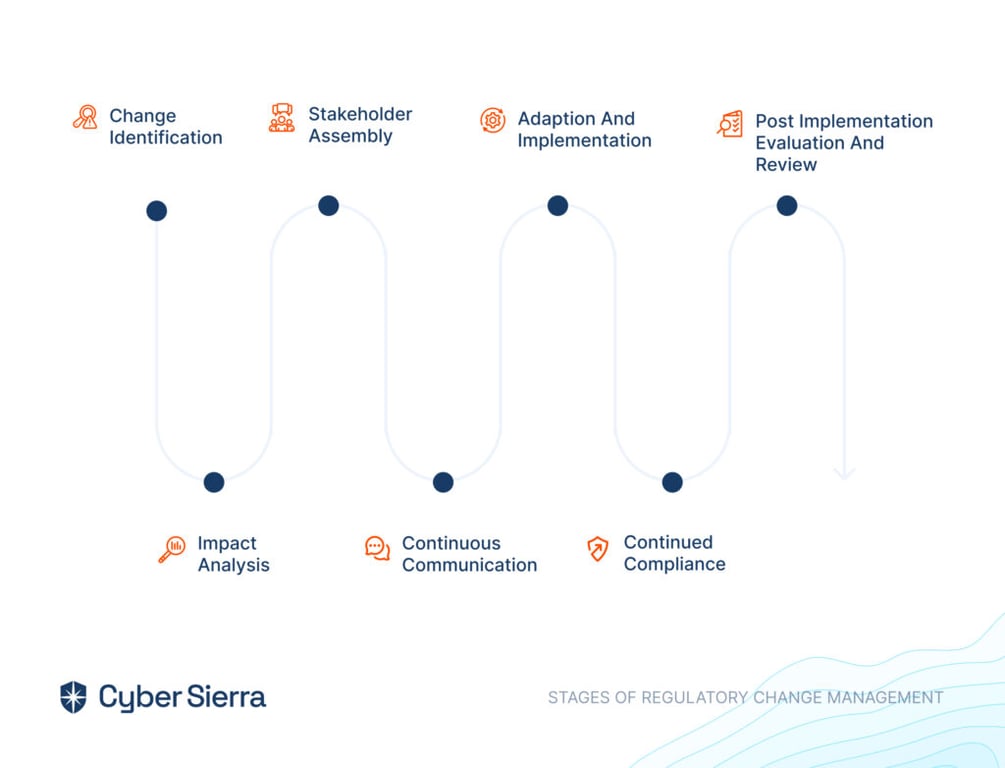
Change Identification
Regulatory change management begins with the identification of change. These changes can be
- Internal – stemming from within the organizational environment and thus subject to management’s control. Deciding to introduce a new product or reaching a targeted loan, volume threshold, or asset size are some examples of internal changes.
- External – stemming from regulations that are external to your organization, such as changes in state laws or national guidelines. Information regarding such changes can be gathered from keeping abreast of lawsuits, regulatory guidance, speeches, blogs, and notifications from cybersecurity organizations like the International Association of Privacy Professionals (IAPP) and National Cybersecurity Alliance.
Regardless of whether a regulatory change is internal or external, your organization needs to formulate an appropriate response. In order for this response to be implemented in a timely and relevant fashion, an effective framework needs to be in place to identify these changes and cut down on your response time.
The manual iteration of this process would entail the appointment of specific personnel, such as a compliance officer, to track and read changes to established regulations, regularly, day in and day out. To avoid the tedious nature of this endeavor, most institutions prefer to automate the task of change identification, so that the process of interpreting and implementing the appropriate modifications to deal with changes might begin sooner. Automating the process also frees up your compliance resources to concentrate their energy on other aspects of the change management process.
Impact Analysis
Impact analysis is the stage that follows change identification in which you attempt to understand how the identified change will impact your institution. Some regulatory changes might not require any action in response, while others may require an immediate and powerful action plan.
Some questions that you need to ask to carefully assess the potential impact of a regulatory change are:
- Which specific services, products, or business activities are going to be affected?
- Which institutional systems are connected to the services, products, and business activities that might be affected?
- Which are the relevant departments or involved stakeholders in the smooth functioning of the potentially impacted product or service?
- What is the level of clearance of all involved stakeholders, and how frequently do they need to be updated regarding regulatory activities?
- In the event of institutional impact, will you have to consider outsourcing to a third-party vendor, or can your action plan be contained in house?
- How severe is the expected impact?
After assessing the extent and nature of the potential impact, you can create a time estimate for the implementation of an action plan. Keep in mind your institution’s resource constraints and keep a detailed account of your strategic process for future reference in the event of more changes.
Before you set your action plan into motion, you must also identify the institutional departments, people, or third-party vendors that need to be involved in the process. Knowing your dependencies on these factors will increase the effectiveness of your change management plan in the long run.
Stakeholder Assembly
Assembling all involved stakeholders is crucial to distribute responsibility for change management in a streamlined way. The right change management team involves the identification of people either within your institution or outside of it who demonstrate the necessary expertise that will prove relevant to the change being dealt with.
Whether you need professionals from the operations department, IT, HR, or compliance department, or need to outsource management to a third party – these are all important decisions to make at this stage. For example, if your action plan involves the implementation of new technology, you will need the help of IT professionals.
Once your regulatory change management team is established, make sure to assign responsibility for specific action items. Every member of your team must understand their role and possess clarity on their assigned tasks. A system needs to be set up for continued accountability within stakeholders.
Internal stakeholders also include senior management, C-suite professionals, and the board of directors. All of them play a key role in supervising the change management process.
Continuous Communication
Effective communication between relevant organizational stakeholders is crucial for the smooth implementation of a regulatory change management plan. The involvement of board members, senior management, and C-suite professionals speeds up the processes of internal institutional communication such as
- The authoritative communication of change to all tiers of your organization,
- Vocal endorsement of your proposed change within the organization by showing visible commitment to your action plan,
- Approval of important buy-ins necessary for the successful implementation of your action plan.
Your shortlisted change management team members should meet on a regular basis in order to review progress, address upcoming issues, and set priorities and feedback mechanisms for the duration of the change management activities.
Keep in mind that it is preferable to over-communicate than under communicate. Ongoing communication is indispensable when it comes to change management because you’re dealing with high stakes changes involving multiple stakeholders and a considerable amount of strategic risk.
Make sure that you report regulatory changes to senior management regularly. Some pointers for what you need to include in your reports are given below:
- Change summary – this will provide a quick briefing of the change that you need to communicate and why it matters to your institution. This section of your report must be succinct and to the point.
- Action plan progress – this section of your report will detail whether said deadlines are being met as expected. Any additional issues that arise concerning meeting your team’s assigned task targets or vendor deliverables need to be included in your action plan progress report.
- Challenges – challenges to the implementation of your action plan that could be needed to be reported immediately. This section of the report should also include your recommendations to overcome these challenges so that the senior management can make informed decisions.
- Budget report – this lists and evaluates all your cost estimates as part of the regulatory change process. Any updates to your anticipated cost, including notable additions or re-estimations must be communicated.
Having a clear and comprehensive record of your regulatory change management reports is invaluable as a record of change management activities that have been undertaken. Compliance, auditors, and examiners can refer to these extensive reports in the future if they need a detailed look at your processes for legal purposes.
Adoption and Implementation
Adapting to regulatory changes involves the crafting of a robust action plan. You need to develop a complete plan to modify existing procedures, policies, and practices to comply with new regulations. This can involve everything from ensuring that your documentation is updated, to training employees so that they are better equipped to keep up with the changes, to investing in new technologies, or even restructuring your institution’s workflows.
A good action plan involves the following:
- A thorough research of the change in question,
- An evaluation of the change’s impact on specific processes,
- Identifying and updating policies and procedures as required,
- Conducting the necessary risk assessment within your institution,
- Detailed plan of internal and external communication,
- An up-to-date staff training program,
- A framework for testing before the plan’s institution-wide implementation,
- A continuous monitoring setup, and
- A continuous reporting setup.
The next thing you need to do is to implement this action plan, which should be easier now that you have set up the chain of communication within your institution!
Post Implementation Evaluation and Review
Once your implementation is underway, and the change proposed has taken place, it is time to move on to the next stage of regulatory change management – the post implementation evaluation.
This review should be communicated across all relevant departments and involve stakeholders whose insights should be included and taken into account. This stage is crucial to understanding exactly how effective and efficient your action plan has been. Additionally, you can also:
- Identify gaps or issues that have not been addressed by your original action plan,
- Understand whether your proposed change has fulfilled, its aims and objectives, and if its impact has been brought about within the estimated cost and time frame, and
- Identify areas of improvement after conducting a thorough analysis of whether the change management process has been effective for your institution or organization.
Continued Compliance
Regulatory change management cannot be complete without planning for the future. Remember that change management is a continuous process. Establish a culture of ongoing compliance by ensuring that you have the necessary mechanisms in place for continuous monitoring in the future, to ease your institution’s evaluation of and adaptation to future regulatory changes.
Regulatory Change Management Framework
Having a sophisticated regulatory change management framework can help streamline the above mentioned processes of monitoring, assessing, and implementing regulatory changes. Outline below are some important features of a robust and automated regulatory change management framework.
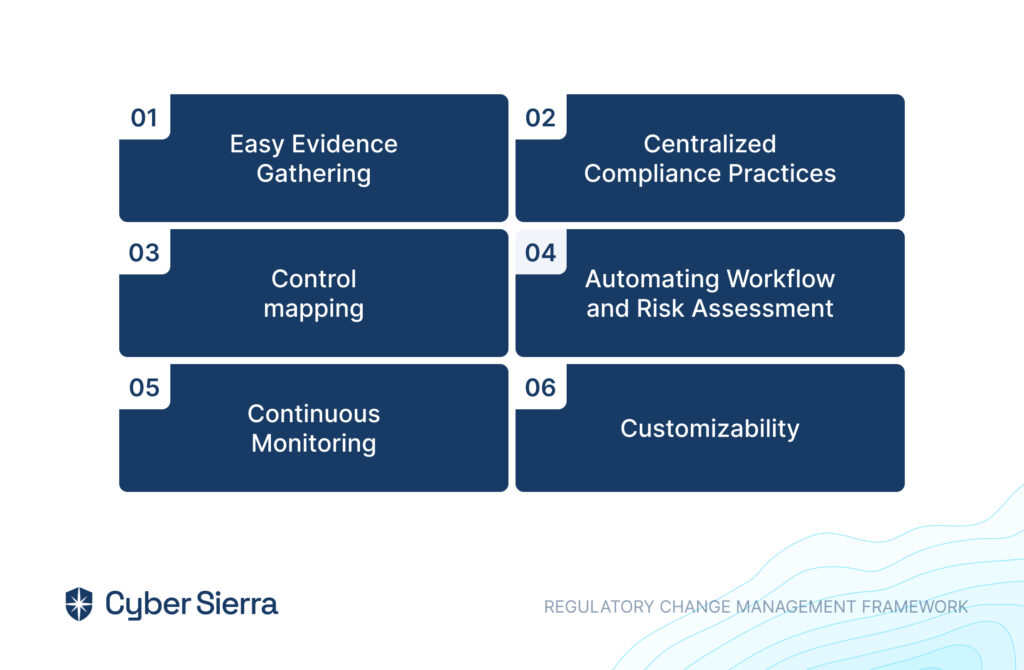
A good regulatory change management framework automates evidence collection, so your manual overhead of proving compliance is reduced. This is especially helpful as your company or organization scales up.
-
Centralized Compliance Practices
A robust framework centralizes, organizes, and updates, regulatory requirements, controls, and evidence simultaneously in a way that is easily comprehensible and accessible. This greatly helps in facilitating your change management process on an institutional level and enjoying smooth collaboration among all involved stakeholders.
Control mapping refers to mapping the control set of one regulatory framework to the requirements of another framework in order to identify common control. This greatly cuts down on the time and resources involved in adopting new changes, since you can quickly identify parts of your existing framework that you do not have to modify.
-
Automating Workflow and Risk Assessment
By automating your workflow, regulatory change management platforms can ensure efficient task management across all organizational tiers. Risk assessment also becomes easier as there are features such as risk rating and heat maps which can help you prioritise regulatory changes based on their potential impact.
The tedious process of continuous monitoring becomes seamless with the right regulatory change management framework, providing compliance professionals with real-time updates and a bird’s eye view of the effectiveness of regulatory changes as well as your organization’s overall security posture.
A notable feature of a good regulatory change management framework is its flexibility. This framework should be able to meet the specific needs and requirements of your organization’s multiple points of contact, including vendors and third-party companies.
Key Challenges of Regulatory Changes
Regulatory changes can come with their own set of problems. Five key challenges faced in the process of regulatory change management are:
-
Rapidity of Regulatory Changes
Regulatory processes are complex and constantly evolving, with a variety of rules and regulations at local, national, and international levels. When a regulatory change is put into motion, it can often lead to rapid consequences since it is driven by fluctuating factors such as changes in geopolitical landscapes, technological advancements, and market risk. It can be overwhelming for change management teams to keep track of all changes simultaneously while calculating the possible implications for their organization.
Regulatory changes are often open to interpretation. Thus, without prior knowledge or experience in internal compliance or in an audit department, it can be difficult to know which regulatory criteria to prioritize and which remediating measures to implement. This challenge is also why more organizations and financial institutions opt for automation and technology adoption when it comes to regulatory change management.
Sometimes the implementation of regulatory changes leads to disruptions in existing operations which can require your institution to make adjustments to the change management process on the go. This can involve decision-making when it comes to your organization’s products and services, which can further hinder operative efficiency.
Furthermore, not implementing these changes might lead to operational disruption as well. Keep in mind that while the SEC and other agencies that do not explicitly prescribe compliance to change management programs can nonetheless flag institutions for reduced operational efficiency, customer confusion, inadequate communication, customer service issues, or reputational risk, which are all consequences of a failure to adapt to regulatory changes.
-
Enacting regulatory changes can often require significantly expensive actions, such as
-
updating procedures and policies
- keeping your systems up-to-date, and
- training and hiring specialized personnel
However, failure to comply with regulatory changes can result in significant fines, penalties, legal actions, and reputational damage in the long run. This can prove to be more of a setback than the cost of setting up a robust regulatory change management framework in the first place.
For instance, the delay of breach notification in the absence of an automated framework to send timely alerts can result in a HIPAA violation. Institutions have been flagged for technical violations in the past, for similarly ignoring regulatory updates.
Regulatory fragmentation can be a daunting challenge in the regulatory change management process. It refers to the overlapping and conflicting nature of regulations, depending on the geographical location and jurisdiction of different regulatory bodies.
Thus, navigating this fragmentation and coordinating your regulatory tasks and frameworks accordingly to ensure compliance, and avoid compliance risk with any and all applicable requirements can be a resource intensive process.
Now that we are aware of the key challenges faced in the enactment of regulatory changes, let’s acquaint ourselves with some best practices to further streamline the process!
Regulatory Change Management: Best Practices
Risk assessment is imperative to the regulatory change management process. Thorough risk assessment can be used to handle the launch of a new product or service, deal with changes in vendor relationships or internal systems, or even provide insight into your institution’s overall regulatory environment.
-
Management and Responsibility
Senior management must decide Whether a formal committee or task force needs to be formed over regulatory changes. Compliance committees are popular and provide a good space to discuss and supervise change implementation. These committees can be in-house and permanent or be temporarily formed to deal with a specific change. Either way, regardless of which type of committee or task force is formed, having a responsible body in charge of your regulatory content framework goes a long way in ensuring that the process isn’t compromised.
At least one member from senior management should be directly involved in the change process. This is so the process of decision-making becomes more seamless with the involvement of a higher authority. Strategic objectives should be accomplished on time, and this is more likely when the responsible committee is held accountable, on a regular basis.
As a compliance professional, you must endeavor to identify the vendors that are going to be the most significantly impacted and communicate incoming changes to them swiftly.
In case of an event where your institution or organization’s existing vendors cannot comply with your updated policies and procedures in the event of significant regulatory changes, you might have to deal with a renegotiation of contractual and regulatory obligations, or, in extreme cases, look for new vendors to source.
In the process of regulatory change management, different documents will be involved. Keeping track of all possible documents infected and ensuring their updation is crucial because an official record of your written policies and procedures can mitigate issues in case of an internal or external audit. Simultaneously, older policies and procedures that are redundant should be wiped from all your systems and network drives, so there is no confusion about current policies.
By now you should know that the implementation of regulatory changes increases compliance risk. Schedule an audit within a year of change implementation to ensure that your institution’s interests are secure.
An important part of regulatory change management is having your controls in place on time. This can be done by readying the changes to be implemented ahead of time so that you have time to monitor their effectiveness. Compare their results against monitoring and quality control checklists that you have maintained prior to the implementation of these changes, and communicate the results to senior management.
Keep in mind that even these monitoring and quality control checklists will have to be updated in line with the new changes.
These best practices should help your company prepare for shifts that impact your business’ efficiency. They will strengthen your flexibility and better position your internal procedures and processes to leverage these changes to your advantage, thus allowing you to succeed in the market!
How Can You Implement Regulatory Changes Effectively?
Many industry professionals recommend the automatization of regulatory change management for the best results. The right regulatory change management software (RCMS) can help with:
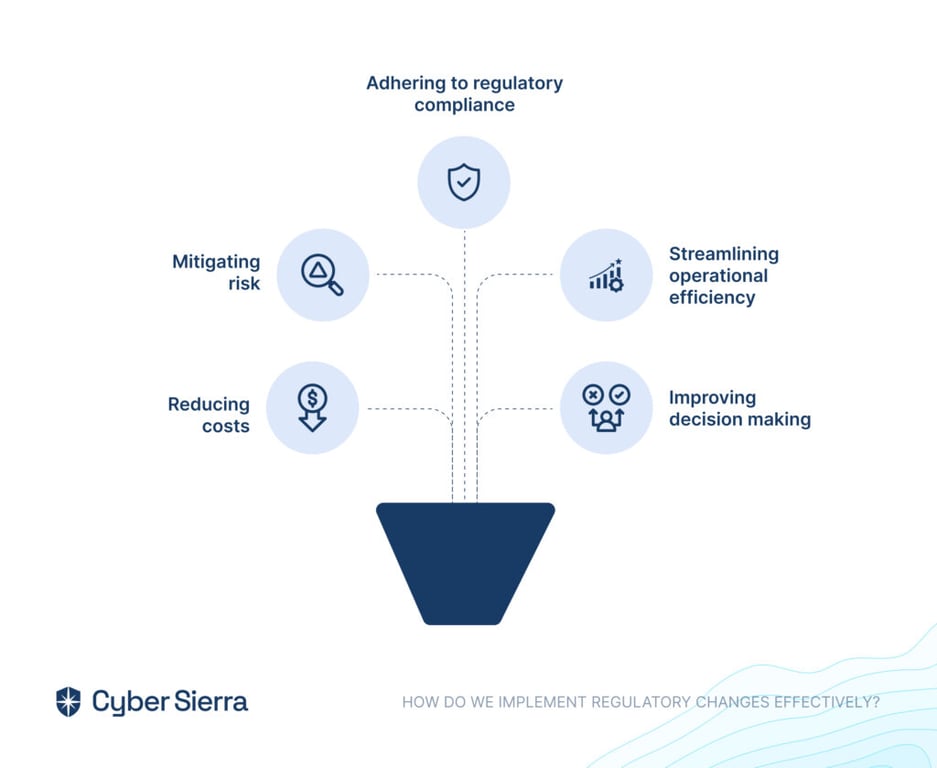
- Adhering to regulatory compliance – this minimizes the risk of non-compliance, penalties, legal issues, and potential reputational damage, in the long run.
- Mitigating risk – implementing regulatory changes effectively by automating, the process will mitigate risk associated with non-compliance and help your institution address potential risks before they escalate.
- Streamlining operational efficiency – a good RCMS will reduce compliance confusion, enable the successful replication of your processes, and cut down on operational delay in the implementation of changes.
- Reducing costs – an RCMS ensures the proactive adoption of regulatory changes which can save costs by avoiding fines, penalties, and potential legal fees that come with non-compliance.
- Improving decision making – Valuable insights provided by a robust RCMS will empower C-suite professionals, board members, and senior management to make better decisions in a way that can align your resources and strategies effectively.
How can Cyber Sierra help?
Cyber Sierra is an innovative AI-driven platform designed to revolutionize security and regulatory compliance for organizations of all sizes. By leveraging advanced machine learning algorithms, Cyber Sierra not only simplifies compliance processes but also adapts to the ever-changing landscape of regulatory requirements.
Cyber Sierra’s capabilities in risk assessment and continuous monitoring make it a critical component for organizations aiming to secure their attack surface, meet ISO certification requirements, and maintain robust security practices in order to mitigate compliance risks.
Cyber Sierra provides the following features that make it ideal for your regulatory change management framework:
-
- Customizable Compliance Templates: Access a library of pre-built, customizable templates based on recognized compliance standards. These templates automatically update to reflect the latest regulatory changes, ensuring your assessments are always current.
- Intelligent Gap Analysis: Cyber Sierra’s AI compares your current practices against updated regulatory requirements, identifying potential compliance gaps. It then provides actionable recommendations to bridge these gaps efficiently.
- Continuous Monitoring and Reporting: Our platform offers near real-time monitoring of your compliance status. Detailed reports highlight vulnerabilities, their severity, and potential impact, allowing for quick remediation.
- Seamless Integration: Cyber Sierra integrates effortlessly with your existing development and security tools, supporting DevOps teams in embedding up-to-date compliance requirements into their workflows.
- User-Friendly Interface: With an intuitive design accessible to users of all skill levels, Cyber Sierra accelerates vulnerability detection and management processes. This ease of use enables quick responses to emerging threats and regulatory changes.
- Comprehensive Scanning: Cyber Sierra performs in-depth scans of an organization’s entire attack surface, including networks, servers, endpoint devices, and third-party applications.
- Comprehensive Risk Profiling: Cyber Sierra creates detailed vendor risk profiles across your entire attack surface, including applications, networks, and third-party systems. This holistic approach ensures no vulnerability goes undetected.
By combining AI-powered analysis, automated regulatory tracking, and comprehensive risk assessment, Cyber Sierra transforms the way organizations approach compliance. Whether you’re a small business managing multiple third-party assessments or an enterprise navigating complex regulatory landscapes, Cyber Sierra niftily handles the complexities of regulatory compliance while you focus on growing your business.
Book a demo here to know how Cyber Sierra can help your organization grow.