Complete Guide to GRC Risk Management [2024]
Are your business risks silently spiraling out of control? In today’s highly regulated business environment, failing to manage risks effectively could mean the difference between success and financial disaster.
That’s where GRC risk management steps in as your safeguard. But with constantly evolving regulations, emerging threats, and complex risk landscapes, how can organizations stay ahead in 2024?
In this complete guide, we’ll walk you through the entire GRC risk management process from the start to the end.
Whether you’re looking to streamline your risk processes, strengthen compliance, or build a more resilient organization, this guide has everything you need to master GRC in the coming year.
Let’s get started.
Key takeaways
- GRC risk management is an integrated approach that helps organizations manage risks while adhering to governance frameworks and regulatory requirements. It combines governance practices, risk assessments, and compliance controls to mitigate internal and external threats.
- The GRC risk management process includes several steps which are building a GRC strategy, engaging stakeholders, conducting risk assessments, creating response plans, implementing controls, continuously monitoring the controls environment, and adopting automation techniques. This structured approach ensures effective risk management and regulatory compliance.
- Involving stakeholders from various departments is crucial for effective GRC risk management. Clear roles, responsibilities, and communication channels foster a risk-aware culture and ensure all stakeholders understand their role in managing risks.
- Conducting thorough risk assessments is vital to identifying, evaluating, and prioritizing risks. Organizations should develop response plans that outline strategies for mitigating or accepting risks, ensuring preparedness for potential threats.
- Regularly reviewing and assessing the control environment is essential for maintaining effective risk management. Organizations must adapt their GRC processes to changes in the regulatory landscape and emerging risks.
- Implementing GRC automation tools enhances efficiency, improves data accuracy, and allows for timely risk responses. Automation streamlines workflows, facilitates continuous monitoring, and ensures that compliance activities are completed efficiently, supporting long-term organizational success.
What is GRC Risk Management?
GRC (governance, risk, and compliance) risk management is an integrated approach that ensures organizations effectively manage risks while staying aligned with their governance frameworks and regulatory requirements. It brings together governance practices, risk assessments, and compliance controls to safeguard an organization from internal and external threats.
The GRC risk management process entails identifying potential risks, evaluating their impact, and implementing control measures to mitigate them. It also involves monitoring ongoing risks, ensuring compliance with relevant laws, and aligning risk strategies with business objectives. This unified approach helps organizations anticipate, manage, and minimize risks across various operations while promoting transparency and accountability.
Two main goals of GRC risk management are minimizing operational and financial risks, and ensuring regulatory compliance. An effective GRC risk management framework reduces potential disruptions while helping businesses stay compliant with industry regulations to maintain their reputation and avoid legal penalties.
Neglecting GRC risk management can lead to two significant drawbacks: increased exposure to financial losses due to unmanaged risks and regulatory violations that may result in fines or reputational damage. Without a proper GRC framework, organizations may struggle to respond effectively to risks and face long-term consequences.
This structured approach ensures organizations are proactive in managing risks while fostering sustainable growth.
The GRC Risk Management Process: A Detailed Guide
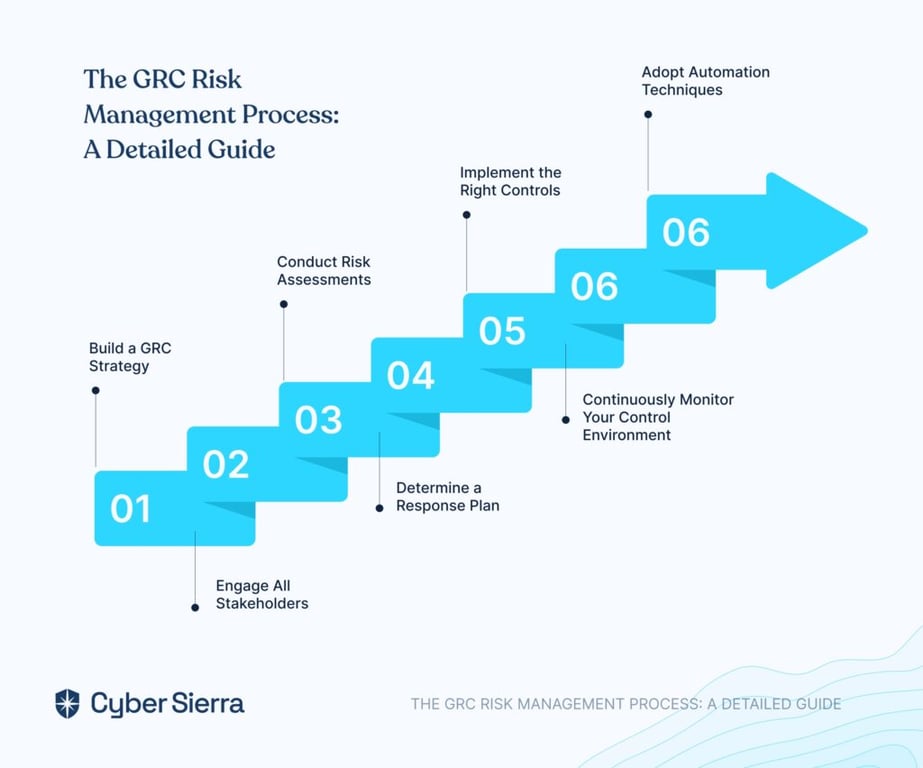
The GRC risk management process involves a structured approach to managing risks that could affect an organization’s operations and regulatory obligations. Here’s an in-depth step-by-step breakdown of the GRC risk management process. At the end of this guide, we’ll show you how Cyber Sierra can help streamline this process.
Step 1: Build a GRC Strategy
The first step in the GRC risk management process is to establish a comprehensive strategy that aligns governance, risk, and compliance with your business objectives, regulatory requirements, and risk appetite.
The main objective of this step is to ensure that your GRC framework supports long-term goals while complying with relevant laws and mitigating risks effectively.
Activities involved in this step include:
- Define GRC objectives: The organization’s goals and values must guide the GRC strategy. Determine the key areas of risk that need monitoring.
- Align GRC with organizational goals: Identify core business goals and develop GRC objectives that complement them. Consider industry regulations, compliance standards (like GDPR, SOX, HIPAA), and internal policies.
- Framework selection: Choose a GRC framework that suits your organization’s risk landscape. COSO, ISO 31000, and COBIT are popular frameworks.
- GRC policy development: Define policies that govern how risks are managed and outline procedures for reporting and responding to risks. These policies should be updated regularly to accommodate evolving risks.
- Set risk tolerance: Establish an acceptable level of risk for the organization. Then allocate resources, both human and financial, to build the infrastructure needed to monitor, assess, and mitigate risks. Balancing risk and business growth is essential here.
Step 2: Engage All Stakeholders
Effective GRC risk management cannot function in silos. To create a robust GRC framework, it’s essential to involve all relevant stakeholders from across the organization. Stakeholder engagement ensures that all departments understand their roles in risk management, compliance, and governance.
Here are the key activities involved in this step:
- Identify key stakeholders: This includes executives, department heads, compliance officers, legal teams, IT security teams, risk managers, external auditors, and others. The goal is to gather input from all parts of the organization to understand their risk perspectives.
- Set expectations and roles: Clearly define roles and responsibilities for each stakeholder group. This will help in the effective delegation of tasks such as risk identification, compliance reporting, and audits.
- Establish clear communication: Develop clear communication channels that facilitate the sharing of information between stakeholders. Tools like centralized dashboards and project management software can support this step.
- Promote a risk-aware culture: Ensure that all stakeholders are educated on the importance of GRC and how it impacts their daily operations. Offer training sessions on the latest regulations, risk management practices, and use of GRC tools. Make risk awareness a part of your organization’s DNA. Training programs, workshops, and periodic reviews can help embed a culture of responsibility.
Step 3: Conduct Risk Assessments
Risk assessment is the core of any GRC risk management process. It involves identifying, evaluating, and prioritizing risks that could negatively impact the organization. This step helps organizations stay ahead of potential threats and vulnerabilities.
Activities involved in this step include:
- Risk identification: Conduct workshops, audits, and interviews to identify risks across various areas like cybersecurity, finance, operations, and compliance. Common tools used here include SWOT analysis and risk registers. From there, list potential risks across various operational areas—financial, IT security, compliance, and operational risks. Use frameworks like NIST (National Institute of Standards and Technology) or COSO for guidance.
- Risk analysis: Analyze each identified risk to assess its likelihood and impact. This can be done using qualitative or quantitative methods, depending on the type of risk and available data. Once done, rank each risk based on the likelihood of occurrence and its potential impact on business operations.
- Risk prioritization: Use a risk matrix to prioritize risks based on their severity and potential impact on the organization. Critical risks need immediate attention, while lower-priority risks can be managed over time.
- Documentation and reporting: Maintain a detailed record of all identified risks, their assessments, and their rankings. These reports serve as the foundation for future decision-making and response planning.
Step 4: Determine a Response Plan
Once risks are assessed and prioritized, the next step is to create a response plan. The response plan details how the organization will manage each identified risk, including strategies for mitigating, avoiding, transferring, or accepting risks. Developing a response plan ensures that your organization is prepared to act if these risks materialize.
Activities include:
- Select risk responses: For each prioritized risk, decide whether to avoid, reduce, transfer, or accept it. The chosen response depends on your organization’s risk appetite, resources, and the nature of the risk. Up to this step, you choose whether to eliminate activities that expose the organization to unacceptable risks or implement controls to minimize the likelihood or impact of the risk. You can also decide to shift the risk to another entity (e.g., through insurance or outsourcing) or if the risk is minor or the cost of mitigation outweighs the benefit, you may accept it.
- Develop mitigation plans: Create detailed plans to reduce the impact of high-priority risks. This could involve strengthening cybersecurity protocols, enhancing internal audits, or adopting new technologies.
- Assign ownership: Assign specific teams or individuals responsibility for managing each risk and carrying out the mitigation strategies.
- Set monitoring mechanisms: Establish ongoing risk monitoring to ensure that response plans are effectively implemented and remain relevant as risks evolve. This step may involve automated tools for continuous monitoring and regular reviews.
Step 5: Implement the Right Controls
Once risks have been identified, assessed, and prioritized, the next step is to implement the appropriate controls to mitigate those risks effectively. Controls are processes, policies, or tools that help reduce the likelihood of a risk event occurring.
They can be preventive, detective, or corrective, and they should align with the organization’s risk appetite and compliance requirements.
Activities involved in this step include:
- Select control types: Determine which controls are most suitable based on the type of risk identified. Preventive controls aim to avoid risk occurrence (e.g., firewalls, access controls). Detective controls focus on identifying and reporting when risks occur (e.g., intrusion detection systems). Corrective controls, on the other hand, are for mitigating the impact of risks after they have occurred (e.g., incident response plans).
- Develop control policies: Create clear policies and procedures that outline how controls will be implemented, monitored, and maintained. This includes defining responsibilities for control owners and stakeholders.
- Train staff: Provide training to ensure that employees understand the controls and their importance. Employees should know how to implement controls effectively and report any issues.
- Documentation: Maintain comprehensive documentation of all controls, including their purpose, implementation procedures, and assigned responsibilities. This is essential for audits and compliance reviews.
- Integration: Integrate controls into daily operations and systems, ensuring that they are not just theoretical but actively practiced within the organization.
Step 6: Continuously Monitor Your Control Environment
Continuous monitoring is essential for ensuring that implemented controls remain effective over time. Organizations need to regularly assess their control environment to identify weaknesses and areas for improvement. Controls also need to be updated based on new risks and changes in the business environment.
Here are the activities involved in this step:
- Establish monitoring processes: Set up processes to regularly review and evaluate the performance of controls. This could include routine checks, audits, and assessments.
- Establish and monitor key risk indicators (KRIs): KRIs are metrics used to measure the likelihood of a risk occurring. Set up regular reporting processes to track KRIs and ensure that any deviations from normal operations are addressed.
- Incident reporting mechanisms: Implement systems for reporting incidents and anomalies. This allows for quick responses to any breaches or failures in control mechanisms.
- Feedback loops: Create feedback mechanisms where employees can report on the effectiveness of controls. This information is vital for making necessary adjustments.
- Regular internal audits: Conduct periodic audits to ensure that controls are being followed and are functioning as intended. Audits help to uncover any gaps in the risk management process.
- Adapt to regulatory changes: The regulatory landscape evolves, and your GRC program must evolve with it. Stay informed of new regulations or industry guidelines.
Step 7: Adopt Automation Techniques
As organizations grow, manually managing the entire GRC risk management process becomes unsustainable. This is where automation comes in. Automation can greatly enhance the efficiency and effectiveness of the GRC risk management process. Automation tools can streamline workflows, improve data accuracy, and ensure timely response to risks.
Activities involved in this step include:
- Implement GRC software: Utilize GRC platforms that offer automation features for risk assessment, compliance management, and reporting. These tools can centralize data and make it easily accessible. Automated tools can identify and assess risks based on predefined criteria, significantly speeding up the process as well.
- Automate reporting: Develop automated reporting systems that generate compliance and risk management reports regularly. This saves time and reduces human error.
- Continuous risk assessment: Employ tools like Cyber Sierra that allow for continuous risk assessments and monitoring of control effectiveness, enabling real-time insights into the organization’s risk posture.
- Workflow automation: Automate workflows related to incident management, approval processes, and policy updates. This improves efficiency and ensures compliance activities are completed on time.
- Integrate with existing systems: Ensure your automation tools can integrate with existing systems (such as HR, finance, and IT) to facilitate a holistic approach to risk management.
By following these steps, organizations can better manage potential risks, ensure regulatory compliance, and create a governance framework that supports long-term success. Integrating a GRC process not only protects against unforeseen threats but also fosters transparency and accountability, helping companies navigate the complexities of today’s business environment.
How Cyber Sierra Can Help Automate the GRC Risk Management Program
The GRC risk management process is a vital aspect that helps organizations manage their risks while ensuring compliance with regulatory standards. By implementing the right controls, continuously monitoring the control environment, adopting automation techniques, and leveraging specialized tools, organizations can enhance their risk management capabilities significantly.
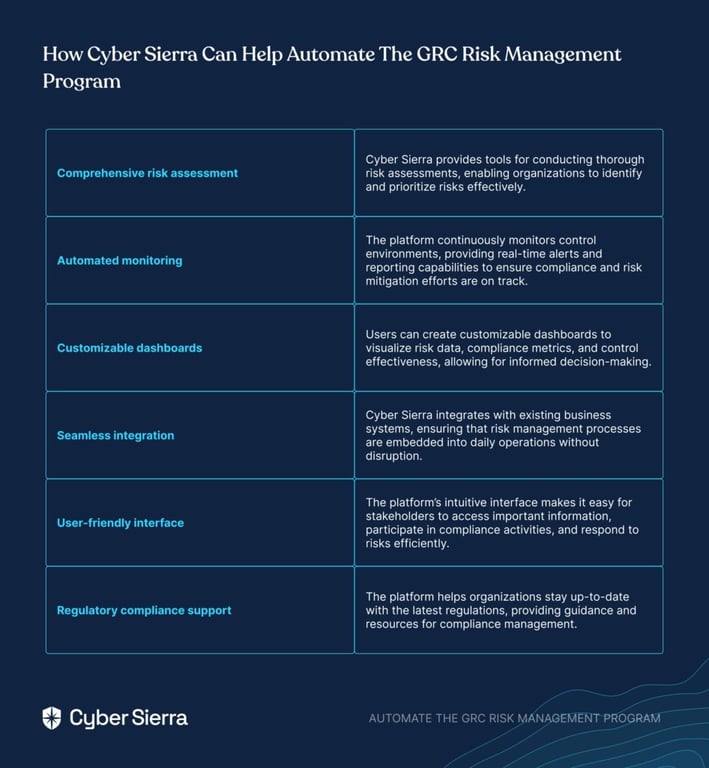
Cyber Sierra is a platform designed to simplify and enhance the GRC risk management process through automation and intelligent insights. It offers a suite of features tailored for organizations aiming to strengthen their governance and risk management frameworks.
Here are key features of the platform that support GRC risk management.
- Comprehensive risk assessment: Cyber Sierra provides tools for conducting thorough risk assessments, enabling organizations to identify and prioritize risks effectively.
- Automated monitoring: The platform continuously monitors control environments, providing real-time alerts and reporting capabilities to ensure compliance and risk mitigation efforts are on track.
- Customizable dashboards: Users can create customizable dashboards to visualize risk data, compliance metrics, and control effectiveness, allowing for informed decision-making.
- Seamless integration: Cyber Sierra integrates with existing business systems, ensuring that risk management processes are embedded into daily operations without disruption.
- User-friendly interface: The platform’s intuitive interface makes it easy for stakeholders to access important information, participate in compliance activities, and respond to risks efficiently.
- Regulatory compliance support: The platform helps organizations stay up-to-date with the latest regulations, providing guidance and resources for compliance management.
Book a free demo here to see how Cyber Sierra can help you streamline GRC risk management.
FAQ
1.What is GRC risk management?
GRC stands for Governance, Risk, and Compliance. GRC risk management is an integrated approach that helps organizations manage risks while adhering to regulatory requirements and governance frameworks. It involves identifying potential risks, evaluating their impact, and implementing control measures to mitigate them. This process ensures organizations can navigate complex risk landscapes while promoting accountability and transparency.
2.Why is GRC risk management important?
Effective GRC risk management is crucial for minimizing operational and financial risks and ensuring compliance with regulations. Neglecting GRC can lead to severe consequences, such as financial losses, legal penalties, and reputational damage. By implementing a structured GRC framework, organizations can proactively manage risks, enhance decision-making, and foster sustainable growth.
3.How can automation enhance GRC risk management?
Automation plays a vital role in streamlining the GRC risk management process. Utilizing GRC software can improve data accuracy, facilitate timely responses to risks, and automate reporting tasks. Continuous risk assessment tools enable organizations to monitor their risk posture in real time, making it easier to adapt to changes in the regulatory environment and emerging threats. By integrating automation, organizations can enhance their efficiency and effectiveness in managing risks.